I went to a state school in Wigan. Dean Trust Rose Bridge. Most of my closest friends there were white working class boys and girls who were perfectly capable of achieving strong GCSE grades. Some of them did. Many did not.
It was not because they were not smart enough.
It was because they could not get themselves to start revising on a Wednesday evening. And every tool that existed to help them assumed they already had.
That observation is the entire reason I built StudySnaps.
The bell curve is not a conspiracy, but we can shift it
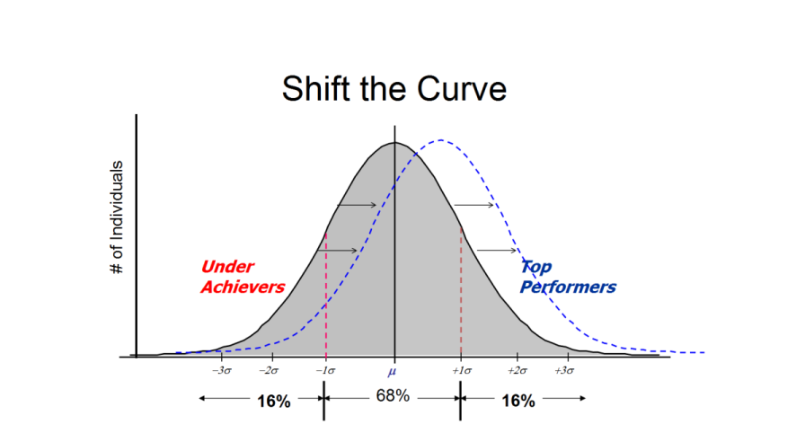
In December 2021, educator and author Tom Sherrington wrote a blog post asking a question that has stayed with me: what would it actually take to shift the performance curve in GCSE education? His argument was that the bell curve is not a conspiracy or a sign of unfair grading. It is a natural distribution. The question is not whether the curve exists. The question is whether we are doing everything we can to move it.
He identified motivation and effort as the first factor worth examining. Students at the lower end of the distribution may not have developed the mental habits needed to engage consistently. They may see the material as irrelevant. They may have become fatalistic about their ability to improve. And so they coast, day after day, without making the connections that would move them forward.
What Sherrington described in classrooms, I have watched happen at home.
What the research showed
In 2025, during my first year at St John Rigby Sixth Form College, I carried out a series of informal research interviews with fellow students. The goal was to test a hypothesis I had formed over years of observing how students actually revise, as opposed to how we are told they should.
I had observed four consistent types. Overachievers, who revise early and often. High achievers, who perform well but often inconsistently. Students who are demotivated but genuinely want to revise and cannot find a way in. And no-revisers, for whom something in the process has shut down entirely.
My hypothesis was that motivation, not ability, is the primary barrier for the middle two groups. And that the right tool, designed around the psychology of starting rather than the mechanics of studying, could shift a meaningful part of the curve.
The interviews confirmed something important and something humbling.
Every student I spoke to at sixth form college had already cleared a significant hurdle. They had performed well enough at GCSE to be there. So it was no surprise that most of them classified themselves as high achievers. The students I was most concerned about, the demotivated but willing, were harder to find in that setting, and when I did find them, they hesitated before classifying themselves that way.
That hesitation told me something. These students know they are not reaching their potential. They are not unaware of the gap. They are just unable to close it with the tools currently available to them.
One student had downloaded Anki at my recommendation. She uninstalled it within two days. Her exact words were: "I didn't understand it. Man, forget this." She was not lazy. She was already using Brainscape because she understood what active recall was and why it worked. She was engaged with the science of revision. But Anki's interface, its learning curve, its friction, defeated her before she started.
That is not a failure of the student. That is a failure of the tool.
The motivation barrier is the attainment gap
Here is what I believe, and what I am building StudySnaps to address.
The attainment gap between high performing students and lower performing students is not primarily a gap in intelligence. It is not primarily a gap in teaching quality. It is a gap in consistent revision behaviour. And consistent revision behaviour is downstream of one thing: the ability to start.
Students who start revising regularly, even imperfectly, build the habit. The habit builds confidence. Confidence builds momentum. Momentum closes gaps.
Students who cannot start do not get that feedback loop. They avoid revision not because they are disengaged but because every revision session begins with a decision that feels enormous. Open the textbook. Create the flashcards. Set up the app. That decision, made at 8pm on a school night when everything else is competing for attention, is where the attainment gap actually lives.
Every existing revision tool is designed for step two. StudySnaps is designed for step one.
One photograph. Instant flashcards. No setup. No friction. No reason not to begin.
And it is not just the student who can do this. A teacher can create a full set of flashcards from their own lesson materials with the same level of ease, and distribute them to every student in the class instantly. Same first push. Same low friction. Same destination. The only difference is who snapped the note.
Shifting the curve is not idealism. It is psychology.
I am a Biology, Chemistry and Maths student. I am not a psychologist. But I have been studying the psychology of motivation, habit formation, and memory since before I had words for it, because I watched it play out in the lives of people I grew up with.
What the research on motivation consistently shows is that activation energy is everything. The harder a behaviour is to start, the less likely it is to happen, regardless of how much the person wants to do it. The easier a behaviour is to start, the more likely it is to become habitual. This is not controversial. It is foundational.
The students who are falling through the cracks in GCSE attainment are not waiting for harder content or more practice papers. They are waiting for a revision tool that does not punish them for not already having their life together. They are waiting for something that meets them where they are, not where we would like them to be.
That is what StudySnaps is trying to build.
What this means for schools
Tom Sherrington's conclusion in his 2021 blog post was that shifting the curve requires, among other things, creating an upward spiral of success and motivation, starting with students at the point they are, not where we would like them to be.
That sentence could be the StudySnaps mission statement.
We are not trying to replace teachers. We are trying to extend what teachers make possible. When a student leaves a lesson and does nothing with that knowledge until the next lesson, a huge amount of what the teacher built is lost to the forgetting curve within days. That is not the teacher's fault. It is not the student's fault. It is a structural problem in how revision is designed.
StudySnaps sits in the gap between the classroom and the exam hall. It takes what the teacher taught and gives every student a personalised, psychology-backed revision system built from their own notes. Not pre-made content that approximates the syllabus. Their notes. Their teacher's explanations. Their understanding of the material.
And it starts with a photograph, because the hardest part of revision is not the revision. It is deciding to start.
Where we go from here
The students I grew up with deserved better tools. The students currently sitting in Year 10 and 11 classrooms across the country deserve better tools. The white working class boys and girls whose attainment the education system has been trying to raise for decades deserve tools designed around the actual barrier they face, not the barrier we assume they face.
We are building those tools. We are doing it carefully. We are doing it with teachers, not around them. And we are doing it from a foundation of genuine psychology research, because the motivation barrier is too important a problem to solve with guesswork.
If you work in a school, lead a trust, or care about what the performance curve looks like for your students, we would love to talk.
Victor Adejumo completed his GCSEs at Dean Trust Rose Bridge as part of the Class of 2025, achieving seven Grade 9s and one Grade 8. He is currently studying Biology, Chemistry and Maths at St John Rigby Sixth Form College, where he is also the co-founder of StudySnaps.
References: Sherrington, T. (2021). Shifting the curve: what will it take? teacherhead.com. Adejumo, V. (2025). No Student Left Behind: Personal Research and a Vision for Educational Equity. Unpublished.